
Bioresonance / NLS Technology & Scientific Evidence
What Is an Oberon Bioresonance Scan?
Oberon is a name used for a family of systems marketed as bioresonance or non-linear analysis (NLS) devices. They are commonly described by promoters as analysing electromagnetic or frequency-related signals and comparing them with reference patterns in software.
Related terms used online include Oberon NLS, Metatron, Metapathia, Oberon analyser, Oberon machine and, less precisely, Oberon biofeedback. These names can refer to different hardware and software versions, so claims about one system should not automatically be assumed to apply to every device sold under similar terminology.
This article explains what these systems are claimed to do, what the scientific and regulatory evidence says about diagnostic and treatment claims, and why an Oberon scan should not be used as a substitute for established medical investigations.
Key Point
Claims that bioresonance devices can diagnose existing or future medical conditions, detect cancer, identify allergies or intolerances, select medicines, or treat disease have not been established by robust clinical evidence. In the UK, the Advertising Standards Authority (ASA) and CAP state that they have yet to see evidence that bioresonance devices can diagnose, prevent or treat disease.
What Oberon / NLS Systems Are Claimed to Measure
Manufacturers and practitioners have described Oberon and related NLS systems as assessing the body through frequency patterns, electromagnetic signals, “entropy” values or spectral comparisons. Historical promotional material has claimed that the software can compare readings with reference patterns for organs, tissues, foods, allergens, microorganisms, medicines or disease states.
These descriptions are claims about the technology. They should not be interpreted as confirmation that the device can accurately identify disease, organ dysfunction, allergy, intolerance, infection, cancer or another medical condition.
Important distinction: a colourful software display or a numerical comparison with a reference library is not, by itself, evidence of clinical diagnostic accuracy. Diagnostic usefulness must be established by appropriate validation against accepted clinical reference standards.
How Oberon Bioresonance Is Said to Work
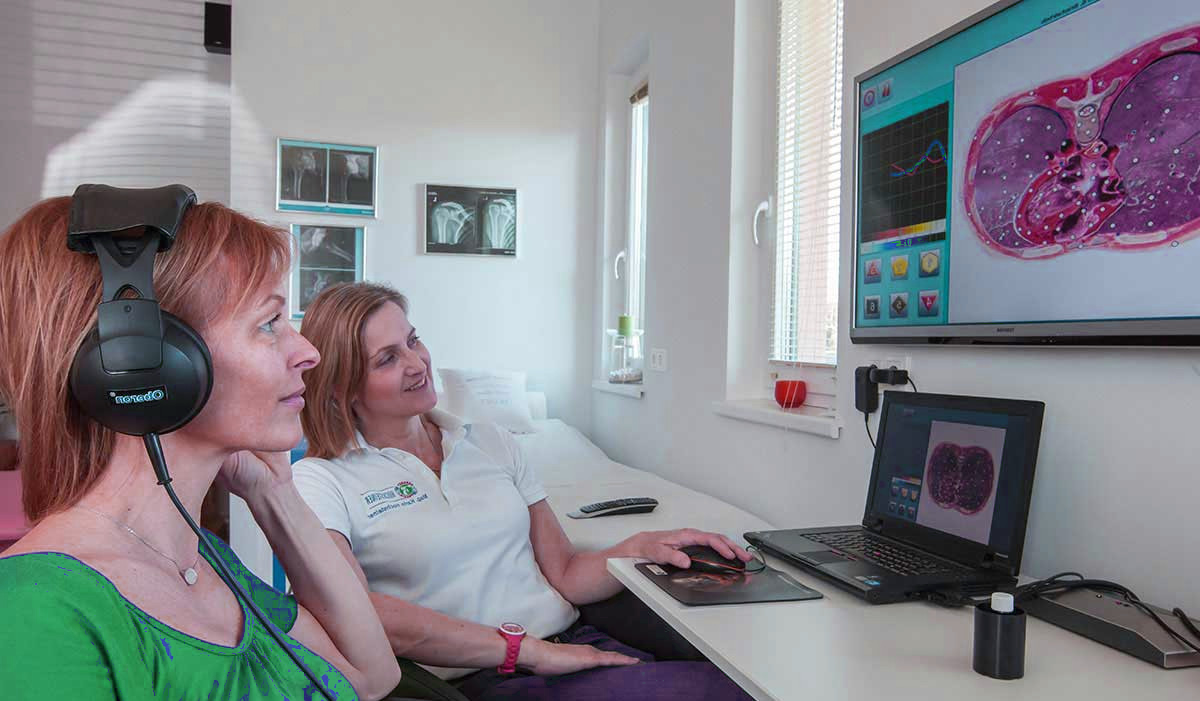
Descriptions of NLS technology often refer to weak electromagnetic signals, resonance, oscillations, spectral analysis and information exchange within biological systems. Some versions are described as using sensors or headphones while software displays anatomical images, coloured markers or comparison scores.
These theoretical explanations should not be confused with established diagnostic methods. Terms such as “quantum”, “entropy”, “resonance” or “frequency” can have precise meanings in physics, but using those words in a device description does not demonstrate that the device can diagnose a medical condition in a patient.
Metatron, Metapathia and NLS Software
Metatron and Metapathia are names frequently associated with NLS systems and their software. Promotional descriptions commonly refer to databases of anatomical images, reference processes and graphical representations that are used to compare a scan result with stored patterns.
The existence of a large software database does not establish that its comparisons are clinically valid. For a diagnostic system to be relied on medically, its outputs need suitable evidence of accuracy, reproducibility and clinical utility for the specific condition being assessed.
Can an Oberon Scan Diagnose Disease?
There is not sufficient robust clinical evidence to treat an Oberon or bioresonance scan as a validated diagnostic test for disease. UK advertising guidance is particularly clear on this point: objective claims that bioresonance can diagnose medical conditions require robust clinical evidence, and the ASA/CAP state that they have yet to see evidence supporting such diagnostic claims.
This matters because an inaccurate result can work in either direction. A false positive can cause unnecessary worry or lead to inappropriate restrictions and treatment. A false negative can provide false reassurance and delay appropriate medical investigation.
Can Oberon Detect Cancer or Tumours?
An Oberon/NLS scan should not be used to diagnose, exclude, stage or monitor cancer. Claims that bioresonance can identify the earliest manifestation of cancer, locate a tumour or follow tumour progression require high-quality clinical validation. Such claims should not replace established cancer pathways, imaging, laboratory tests, pathology or specialist assessment.
If you have a lump, unexplained bleeding, persistent unexplained symptoms, significant weight loss or another symptom that could require investigation, contact your GP or an appropriate medical service rather than relying on a bioresonance scan.
Can Oberon Replace Ultrasound, CT, MRI or Blood Tests?
No evidence-based case has been established for using an Oberon scan as a replacement for clinically indicated ultrasound, X-ray, CT, MRI, ECG, endoscopy, pathology or laboratory testing. Those investigations have defined clinical uses, validation standards and interpretation pathways that are different from bioresonance/NLS systems.
If a conventional investigation has been recommended, a bioresonance result should not be used as a reason to cancel or delay that investigation without discussing the decision with an appropriately qualified healthcare professional.
What Does the Scientific Evidence Say?
The evidence base for bioresonance is limited and does not establish the broad diagnostic and therapeutic claims commonly made for the technology. Reviews of unproven allergy testing methods have included bioresonance among techniques that lack adequate scientific validation and do not reliably correlate with accepted clinical evidence of allergy.
Research in other conditions is also limited. For example, a review of complementary and alternative approaches to atopic eczema reported that a bioresonance study did not show superiority over a sham procedure. This does not prove that every device or every proposed use is identical, but it does illustrate why broad claims of diagnosis or treatment need condition-specific, high-quality evidence.
The most reliable conclusion is therefore not that every theoretical aspect of NLS technology has been disproved, but that the clinical claims made for diagnosing and treating disease have not been demonstrated to the standard required for medical decision-making.
Bioresonance Treatment, “Metazodes” and Remedy Selection
Some Oberon/NLS descriptions go beyond scanning and claim that inverted frequencies, “metazodes”, electromagnetic oscillations or remedy databases can be used to correct imbalances or select an effective treatment. These are treatment claims, not simply descriptions of a wellness scan.
Robust evidence has not established bioresonance as a treatment for disease, nor that software frequency comparisons can determine which medicine, supplement or therapy will be most effective for an individual. A person should not start, stop or change prescribed treatment on the basis of an Oberon/NLS result without appropriate medical advice.
Oberon Biofeedback, Bioresonance and NLS: Are They the Same?
People frequently search for terms such as Oberon biofeedback, Oberon bioresonance and Oberon NLS as if they were interchangeable. In practice, sellers and practitioners may use these labels inconsistently.
“Biofeedback” also has an established meaning in conventional behavioural and physiological monitoring, so using the term for an NLS/bioresonance device can create confusion. When evaluating a particular service or machine, it is better to check the exact manufacturer, model, intended purpose and evidence for the specific claims being made.
Oberon Scan Reviews, Price and Accuracy: What to Consider
Reviews and price can tell you whether someone found a service convenient, interesting or reassuring, but they cannot establish diagnostic accuracy. A positive testimonial does not show that a scan correctly identified disease, and a high price does not imply stronger clinical validation.
If you are considering an Oberon or NLS service, useful questions include: What exact device and software are being used? What medical claims are being made? Is the device intended and regulated for those claims? What clinical validation exists for the specific condition? Will the practitioner advise you to seek conventional investigation when appropriate?
UK Advertising and Medical-Device Context
In January 2026, ASA/CAP guidance stated that objective claims about diagnosing or treating medical conditions with bioresonance require robust clinical evidence and that they had yet to see evidence that bioresonance devices can diagnose existing or future medical conditions, prevent disease or treat illness.
Medical-device registration or conformity marking should not be confused with independent proof that every advertised clinical claim is effective. The MHRA states that registration does not represent accreditation, certification, approval or endorsement by the regulator.
When to Seek Conventional Medical Assessment
Seek appropriate medical advice if you have persistent, worsening or unexplained symptoms; a new lump; unexplained bleeding; significant weight loss; chest pain; fainting; persistent neurological symptoms; or another concern that may require clinical assessment. Do not use a bioresonance result to rule out a serious condition or to delay an investigation already recommended by a healthcare professional.
Separate Laboratory Testing at Parkland Natural Health
Laboratory tests offered by Parkland Natural Health are separate from Oberon/NLS and should not be selected, interpreted or recommended solely on the basis of a bioresonance scan. Where allergy is suspected, laboratory findings still need to be interpreted in the context of symptoms and appropriate clinical assessment.
Available Separately at Parkland Natural Health

Food allergy test
This is a separate laboratory-based service. It is not an Oberon/NLS test and should not be chosen on the basis of a bioresonance result alone.
Sources and Further Reading
- ASA/CAP: Bioresonance Therapy — guidance on diagnosis and treatment claims
- ASA/CAP: non-compliant bioresonance testing claims, updated July 2026
- MHRA: Register medical devices to place on the market in Great Britain
- PubMed: Unproven techniques in allergy diagnosis
- PubMed: Complementary and alternative medicine and atopic eczema
This article discusses Oberon/NLS and bioresonance claims for general information. It does not provide a diagnosis and should not be used to replace appropriate medical assessment, laboratory testing or imaging.
