
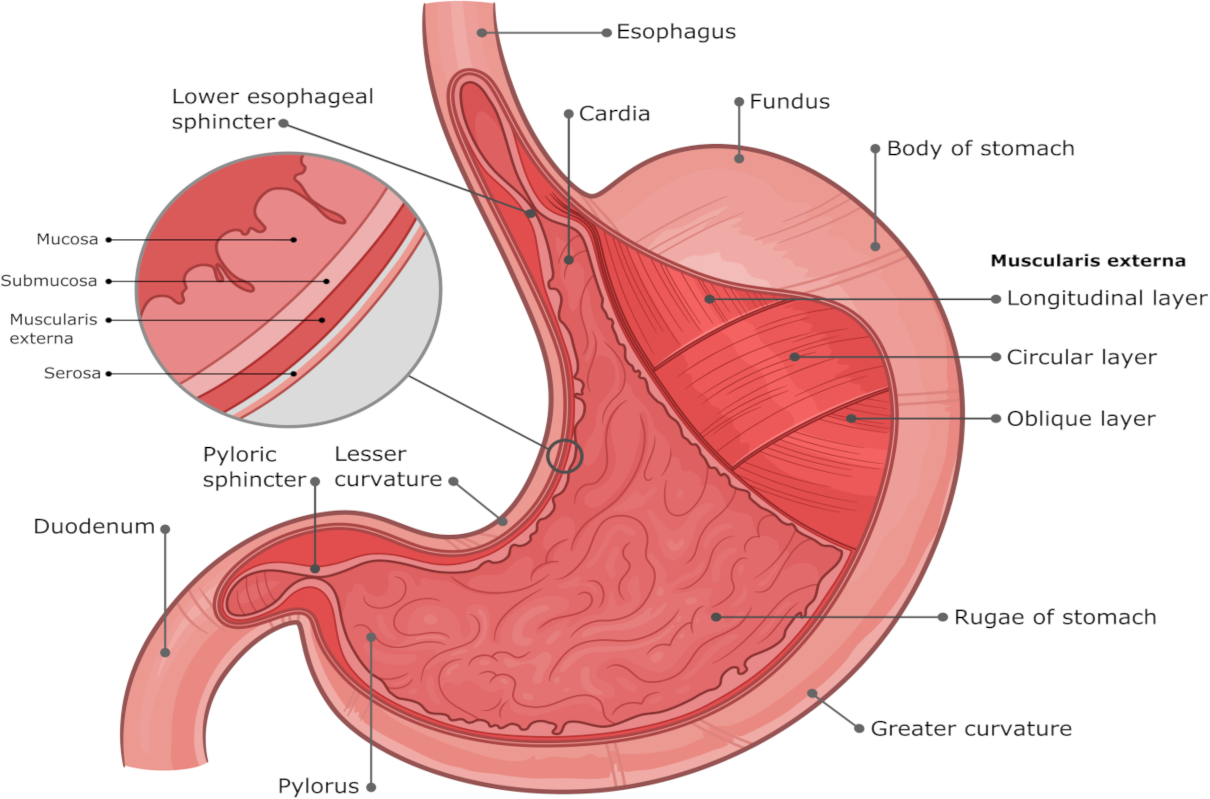
The stomach enlarges the alimentary tract located inferior to the diaphragm. It is a J-shaped organ, and we divide it into four regions:
- The cardia is the immediate region surrounding the cardiac sphincter.
- The fundus is the bulbous portion to the left and superior to the cardia.
- The body is the lower central portion of the stomach.
- The pylorus is the region adjacent to the pyloric valve, which separates the stomach from the small intestine. The outer border of the J-shape is referred to as the greater curvature, and the inner wall is the lesser curvature.
The stomach serves as a food reservoir, a site for mechanical and chemical digestion, and an absorption site for alcohol, water, and some salts. Each day, the stomach secretes two to three litres of gastric juices (water, salts, mucins, HCl, pepsin, rennin, and perhaps gastric lipase). Secretions arise from gastric glands located in the stomach’s mucosal layer. Their chief cells secrete pepsin and rennin. Meanwhile, parietal cells produce HCl. And mucous cells secrete mucin.

Anti-Parasite Herbal Implant + Sodium Bicarbonate Colonic Irrigation
Specialised anti-parasite herbal colonic irrigation in Holborn, Central London, combining closed-system colon hydrotherapy with Practitioner Supplies Anti-Parasite Tincture and a carefully prepared sodium bicarbonate solution.
The professional herbal blend contains wormwood, German chamomile, walnut leaf and clove bud. Parkland Natural Health has used this Practitioner Supplies formulation for around 20 years. Personal consultation and suitability screening are included. Book online and save 10%.
Forms
Pepsin is the major stomach enzyme. It is responsible for reducing proteins to proteoses and peptones. It is secreted in an inactive form, pepsinogen, and is activated in the presence of HCl. Rennin acts on the milk protein casein and has a curdling effect on the milk. Infants’ stomachs have a much higher concentration of this enzyme than adults’ stomachs. Rennin is present in adults but not in vast amounts.
Gastric lipase, as the name suggests, is found in the stomach, but no evidence is present, which indicates that it is produced there. Concentrations of it are deficient. So, it may arrive via the pyloric sphincter from the small intestine. In any event, it can only break down fats into triglycerides. Mucins are secretions from the pyloric mucosa that combine with water to form mucus. It creates a protective barrier against enzymes on the stomach’s inner lining.

Sodium Bicarbonate Mini Detox – 3 Colonic Irrigations
Sodium Bicarbonate Mini Detox is a structured course of three sodium bicarbonate colonic irrigation sessions in Holborn, Central London. It combines closed-system colon hydrotherapy with a carefully prepared sodium bicarbonate solution.
The course is popular with clients interested in bowel regularity, incomplete emptying and the scientific research into sodium bicarbonate’s antifungal activity, including laboratory studies involving Candida. Consultation and suitability screening are included. Book the course online and save 16%.
Stomach and intestine
Enzymatic secretions are under nervous and hormonal control. Food’s sight, smell, and taste also initiate gastric secretions via vagal nerve stimulation (= Cephalic Phase). Undigested food in the stomach triggers gastric secretions and muscular contractions (= Gastric Phase).
When food enters the stomach, the pyloric mucosa releases gastrin, a hormone, into the blood. This hormone initiates the muscular contractions and secretions mentioned above. As the final mass of partially digested food (i.e., usually undigested fats) passes from the stomach to the intestine, the intestine produces a hormone, enterogastrone, which inhibits gastric movements and secretions (= Intestinal Phase).
The stomach acidity (pH = 1.0) is due to a high concentration of HCl. Hydrochloric acid activates pepsinogen, curds milk, plays a minor role in protein digestion (i.e., swells and softens protein), and kills almost all bacteria in the food bolus obtained from the oesophagus.
Liver & Gallbladder Herbal Colonic Irrigation
Specialised liver and gallbladder herbal colonic irrigation in Holborn, Central London, combining closed-system colon hydrotherapy with Practitioner Supplies Enema Herbs, a professional herbal blend formulated for enema use.
The blend contains red clover, raspberry leaf, burdock root, yellow dock and German chamomile. Parkland Natural Health has used this professional formulation for around 20 years, and it remains a popular choice among returning clients. Your appointment includes a personal consultation and suitability screening. Book online and save 10%.