
SMALL INTESTINE SECRETIONS & FUNCTION
What does the small intestine secrete?
Small intestine secretions help create the fluid environment in which digestion and absorption take place. However, digestion in the small intestine depends on several sources working together: secretions from the intestinal lining, pancreatic juice, bile and enzymes located on the brush border of intestinal cells.
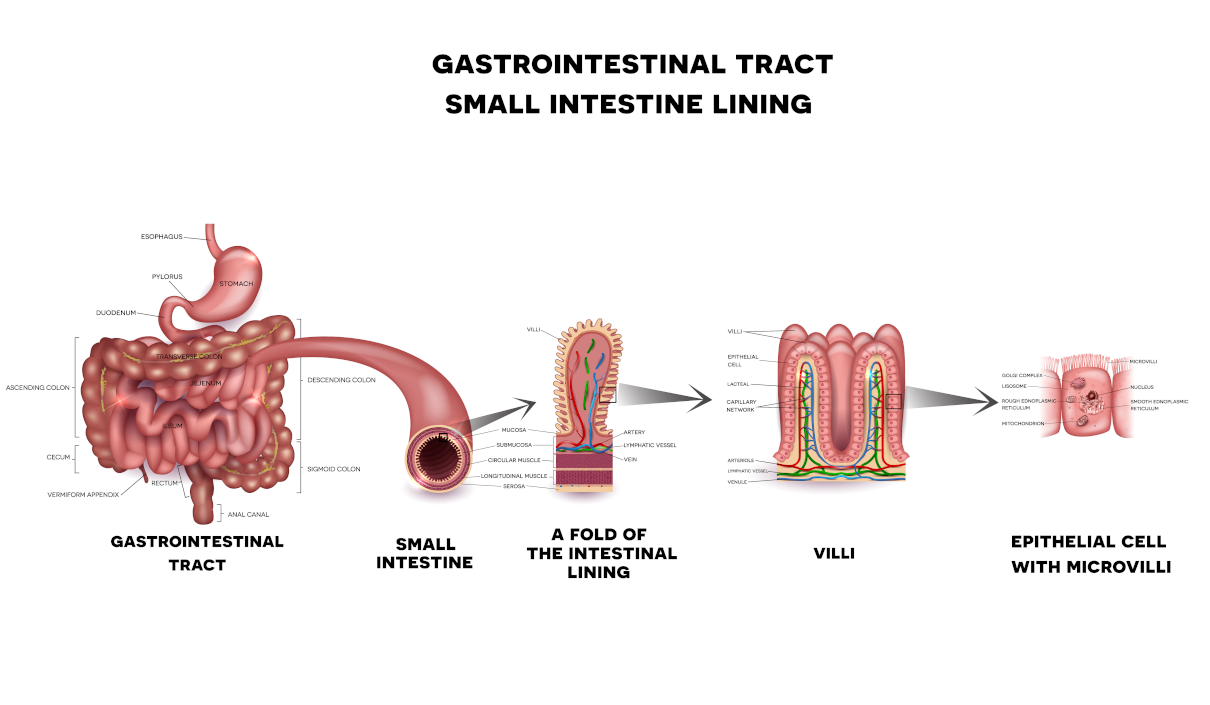
The small intestine is also the principal site where most digested nutrients are absorbed. Its specialised lining, circular folds, villi and microvilli provide a very large surface for this process.
Understanding the difference between intestinal juice, pancreatic secretions, bile and brush-border enzymes helps explain how digestion actually works in the small bowel.
Small intestine anatomy: duodenum, jejunum and ileum
The small intestine is a long, narrow part of the gastrointestinal tract extending from the stomach to the large intestine. Anatomical references commonly describe it as several metres long, although measured length varies between individuals and according to how it is measured.
Duodenum
The duodenum is the first section. It receives acidic chyme from the stomach together with pancreatic juice and bile. Bicarbonate-rich secretions help neutralise the acidic contents and create conditions suitable for intestinal and pancreatic enzymes.
Jejunum
The jejunum is the middle section. Its folded lining and numerous villi provide a large absorptive surface, and substantial absorption of digested nutrients takes place here.
Ileum
The ileum is the final section. It continues nutrient and water absorption and ends at the ileocecal junction, where intestinal contents pass into the large intestine.

Anti-Spasmodic Herbal Colonic + Sodium Bicarbonate
Specialised anti-spasmodic herbal colonic irrigation in Holborn, Central London, combining closed-system colon hydrotherapy with Practitioner Supplies ASP Enema Herbs and a carefully prepared sodium bicarbonate solution.
This option is particularly popular with clients concerned about bowel spasm, cramping or trapped gas, including IBS-type symptoms where spasm or gas is a prominent concern. The professional herbal blend contains raspberry leaf, German chamomile, lobelia, peppermint and motherwort. Personal consultation and suitability screening are included. Book online and save 10%.
The intestinal lining: folds, villi and microvilli
The intestinal lining is highly specialised for digestion, secretion and absorption. Rather than being a simple smooth tube, its inner surface has several structures that greatly increase the area available for contact with intestinal contents.
| Structure | Function |
|---|---|
| Circular folds | Large folds of the mucosa and submucosa that increase surface area and help slow and mix intestinal contents. |
| Villi | Finger-like projections covered by intestinal epithelial cells. Each villus contains blood vessels and a lymphatic vessel involved in nutrient absorption. |
| Microvilli | Microscopic projections on absorptive epithelial cells that form the brush border and provide an even larger surface for absorption and membrane-bound digestive enzymes. |
| Intestinal crypts | Invaginations between villi containing cells involved in secretion, epithelial renewal and intestinal defence. |
Small intestine secretions: what is intestinal juice?
Intestinal juice, sometimes called succus entericus, refers broadly to the fluid environment produced within the small intestine. Water, electrolytes and mucus contribute to this environment and allow nutrients and digestive products to remain in solution while digestion and absorption proceed.
It is important not to think of intestinal juice as the only digestive secretion in the small bowel. Large amounts of digestive activity depend on pancreatic juice, bile and enzymes located on the intestinal brush border.
Secretions from intestinal crypts
Crypt cells contribute fluid and electrolytes to the intestinal lumen. This fluid helps provide the aqueous environment needed for digestion and movement of intestinal contents.
Mucus and duodenal protection
Mucus helps protect and lubricate the intestinal surface. In the duodenum, Brunner glands produce alkaline mucus that contributes to protecting the mucosa from acidic chyme arriving from the stomach.
Small intestine secretions: pancreatic juice and bile
The small intestine does not work alone. Two major accessory digestive organs deliver important secretions into the duodenum.
Pancreatic juice
The pancreas supplies bicarbonate and digestive enzymes. Bicarbonate helps neutralise gastric acid, while pancreatic amylase, lipase, proteases and other enzymes digest carbohydrates, fats, proteins and nucleic acids.
Bile
The liver produces bile and the gallbladder stores and concentrates it between meals. Bile salts help emulsify dietary fats, making them more accessible to pancreatic lipase and assisting subsequent fat absorption.
Brush-border enzymes in the small intestine
Many enzymes important in the final stages of digestion are associated with the brush border of the intestinal epithelial cells rather than simply floating freely in intestinal juice.
| Enzyme | Main action |
|---|---|
| Enteropeptidase | Activates pancreatic trypsinogen to form trypsin. |
| Maltase | Breaks maltose down to glucose. |
| Sucrase | Breaks sucrose down to glucose and fructose. |
| Lactase | Breaks lactose down to glucose and galactose. |
| Peptidases | Help break smaller peptides into absorbable amino acids and short peptides. |
The older term enterokinase is still encountered, but enteropeptidase is the modern name for the brush-border enzyme that activates trypsinogen.
Trypsin and protein digestion
The pancreas releases trypsinogen, an inactive enzyme precursor, into the small intestine. Enteropeptidase activates some trypsinogen to form trypsin.
Trypsin then helps activate additional pancreatic enzyme precursors and breaks protein chains into smaller peptides. Other pancreatic and brush-border peptidases continue this process until products are small enough for intestinal absorption.
Hormones that regulate digestion in the small intestine
Hormonal signalling helps coordinate the arrival of chyme with pancreatic secretion, bile release and digestive activity.
Secretin
Acid entering the duodenum stimulates the release of secretin. Among its important actions is promoting bicarbonate-rich secretion from the pancreas and biliary system, helping neutralise acidic chyme.
Cholecystokinin (CCK)
Fats and proteins in the small intestine stimulate CCK release. CCK promotes pancreatic enzyme secretion and gallbladder contraction and helps coordinate delivery of bile and pancreatic juice into the duodenum.
What is enterocrinin?
Enterocrinin is a historical term found in older physiology literature. It was proposed in the twentieth century as a gut hormone that stimulated secretion from intestinal glands.
The term still appears in textbooks and search queries, but it is not usually listed among the principal gastrointestinal hormones in modern introductory physiology. Current teaching more commonly focuses on established regulators such as secretin, cholecystokinin and other characterised gastrointestinal signalling peptides.
How food moves through the small intestine
Movement through the small intestine combines propulsion with mixing. Peristalsis helps move intestinal contents forwards, while segmentation repeatedly mixes chyme with digestive secretions and brings it into contact with the absorptive lining.
Older physiology texts may also use terms such as pendular movement to describe intestinal mixing movements. Modern descriptions generally focus on patterns such as segmentation, peristalsis and migrating motor activity.
Why is the small intestine important for absorption?
Most nutrient absorption occurs in the small intestine. Digested carbohydrates, amino acids, vitamins, minerals and water cross the intestinal epithelium through specialised transport mechanisms.
Many absorbed nutrients enter blood capillaries within the villi and travel towards the liver. Products of dietary fat digestion follow a different route and are absorbed into lymphatic vessels called lacteals before entering the bloodstream.
The combination of circular folds, villi, microvilli, blood vessels and lymphatic vessels makes the intestinal lining highly adapted for absorption.
Small intestine secretions: frequently asked questions
What does the small intestine secrete?
The small intestine contributes water, electrolytes and mucus to the intestinal environment. It also contains brush-border enzymes involved in the final stages of digestion. Pancreatic juice and bile enter the small intestine from accessory digestive organs and provide additional digestive substances.
What is intestinal juice?
Intestinal juice, or succus entericus, is the fluid environment of the small intestine. It contains water, electrolytes and mucus and works together with pancreatic juice, bile and brush-border enzymes during digestion and absorption.
What does the duodenum secrete?
The duodenal lining contributes mucus, fluid and bicarbonate-rich secretions. Brunner glands are particularly associated with alkaline mucus. The duodenum also releases regulatory hormones such as secretin and cholecystokinin in response to intestinal contents.
What enzymes are found at the small-intestine brush border?
Important brush-border enzymes include enteropeptidase, maltase, sucrase, lactase and several peptidases. They help complete digestion immediately beside the absorptive surface.
What is the function of the intestinal lining?
The intestinal lining performs several functions, including secretion, digestion, nutrient and water absorption, barrier protection and continuous renewal of epithelial cells.
Does the small intestine absorb most nutrients?
Yes. The small intestine is the principal site of nutrient absorption. Its circular folds, villi and microvilli create a large surface through which digested nutrients can enter blood or lymph.
Is enterocrinin still considered an important digestive hormone?
Enterocrinin is mainly a historical physiology term describing a proposed stimulator of intestinal gland secretion. Modern introductory physiology generally emphasises better-characterised gastrointestinal hormones such as secretin and cholecystokinin.
Continue through the digestive system
The small intestine lies between the stomach and the large intestine. Continue with our anatomy and physiology guides to see how these parts of the digestive tract work together.
Sources and further reading
- NIDDK: Your Digestive System & How It Works
- OpenStax Anatomy and Physiology: The Small and Large Intestines
- OpenStax Anatomy and Physiology: Chemical Digestion and Absorption
- Best Practice & Research Clinical Gastroenterology: Physiology of Intestinal Absorption and Secretion
- PubMed: Historical review of enterocrinin as a candidate gut hormone
This article provides general educational information about normal small-intestine anatomy and physiology. It is not intended to diagnose digestive symptoms or replace individual medical advice.
