
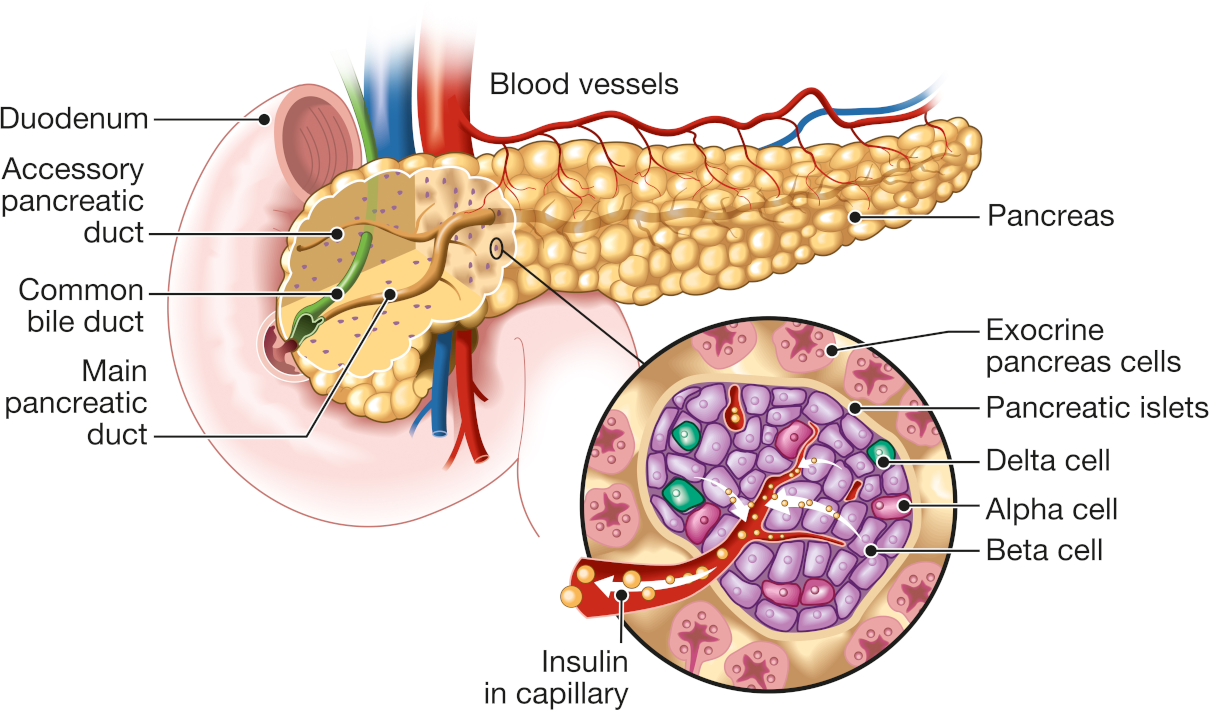
The pancreas is the organ between the greater curvature of the stomach and the duodenum. It is both an endocrine and exocrine gland. It consists of granular-like epithelial cells forming two masses.
- The Islets of Langerhans, which produce endocrine secretions involved with sugar metabolism
- The Acini secrete digestive enzymes of exocrine origin.
Since the pancreas is not part of the small intestine, it must transfer its digestive enzymes through the pancreatic duct (Canal of Wirsung) to the common bile duct. The latter enters the small intestine in a small, enlarged area called the ampulla of Vater.
Pancreas compose
Pancreatic juice is composed of
- Trypsinogen, chymotrypsinogen, and procarboxypeptidase, the inactive forms of trypsin, chymotrypsin, and carboxypeptidase, respectively, are responsible for the total breakdown of complex sugars to disaccharides.
- Lipase reduces fats to fatty acids and glycerol.
- Bicarbonate ion (HC03-) raises the pH of the intestine by neutralizing the HC1 from the stomach. All intestinal enzymes are most active at a pH greater than 7.0.
To sum up, colon hydrotherapy with sodium bicarbonate helps increase pH.

Sodium Bicarbonate Mini Detox – 3 Colonic Irrigations
Sodium Bicarbonate Mini Detox is a structured course of three sodium bicarbonate colonic irrigation sessions in Holborn, Central London. It combines closed-system colon hydrotherapy with a carefully prepared sodium bicarbonate solution.
The course is popular with clients interested in bowel regularity, incomplete emptying and the scientific research into sodium bicarbonate’s antifungal activity, including laboratory studies involving Candida. Consultation and suitability screening are included. Book the course online and save 16%.