
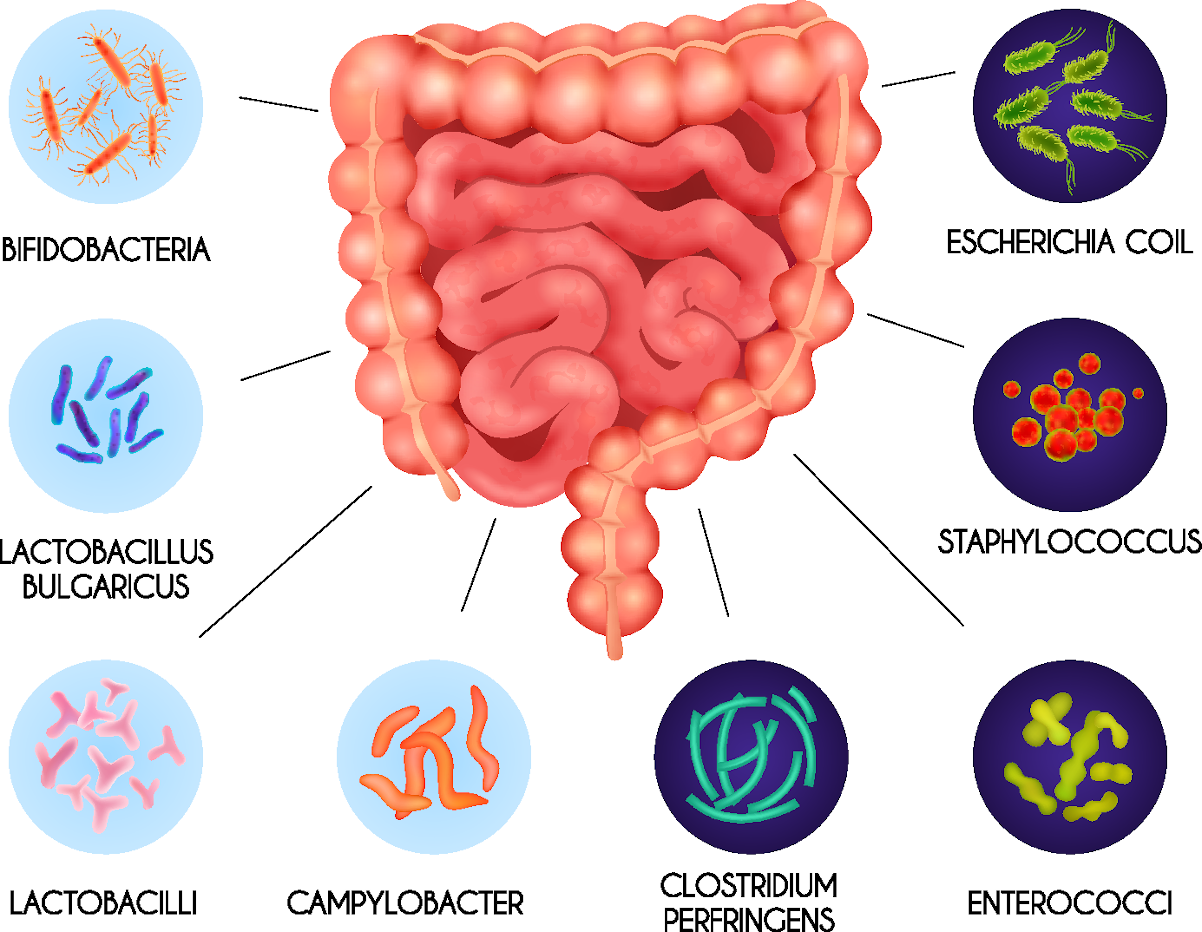
INTESTINAL MICROFLORA & GUT MICROBIOTA
What is intestinal microflora?
Intestinal microflora is a traditional term for the community of microorganisms that live in the digestive tract, particularly the large intestine. These microorganisms include many different bacteria as well as other microbes.
Today, scientists more commonly use the term gut microbiota rather than microflora. The term gut microbiome is also widely used, although it can refer more broadly to the microorganisms, their genes and the environment in which they live.
The intestinal microbiota interacts with food components, the intestinal lining and the immune system. Its composition differs considerably between individuals and can also change over time.
Microflora, microbiota and microbiome: what is the difference?
| Term | Meaning |
|---|---|
| Microflora | An older but still commonly used term for the microorganisms living in a particular environment, such as the intestine. |
| Microbiota | The community of microorganisms present in a particular environment. “Gut microbiota” is the preferred modern term in much scientific literature. |
| Microbiome | A broader term often used for the microbial community together with its genetic material, functions and surrounding environment. |
For practical purposes, people searching for intestinal flora, gut microflora or intestinal microflora are usually referring to the microorganisms that inhabit the digestive tract.

Mini Detox PLUS – 3 Colonics with Herbal & Probiotic Implants
Mini Detox PLUS is a structured three-session colonic irrigation course in Holborn, Central London. Each appointment uses closed-system, gravity-fed colon hydrotherapy with sodium bicarbonate, while the programme adds a different specialist component at each visit: an anti-parasite herbal implant, a liver and gallbladder herbal implant, and a high-strength probiotic implant.
Personal consultation and suitability screening are included. We usually arrange the three appointments over about one week, subject to suitability and availability. Book online and save 16%.
What does the intestinal microbiota do?
The gut microbiota is involved in a wide range of normal biological processes. However, it is better understood as a complex ecosystem than as a simple collection of “good” and “bad” bacteria.
Breaking down food components
Microorganisms in the large bowel can ferment some carbohydrates and fibres that are not fully digested higher in the digestive tract. This process produces metabolites, including short-chain fatty acids.
Interaction with the immune system
Gut microorganisms and the immune system continually interact. These relationships are part of normal immune development and regulation, although the microbiota should not be presented as a simple way to “boost immunity”.
Metabolism
Gut microorganisms contribute to the metabolism of substances including bile acids and certain dietary compounds. Their metabolic activity also influences the environment within the colon.
The intestinal environment
The resident microbiota forms part of the intestinal ecosystem and interacts with the mucus layer and intestinal lining. Many different microbial species compete for nutrients and space.
Is there such a thing as “normal microflora”?
There is no single ideal intestinal microbiota shared by every healthy person. Microbial composition varies between individuals and is influenced by age, diet, medicines, environment, health history and many other factors.
This is why statements such as “a healthy intestine must contain a particular number of bacteria” or “the intestinal flora should weigh two kilograms” are not useful measures of an individual’s gut health.
Modern microbiome research focuses not only on which microorganisms are present but also on what they are doing, how stable the community is and how it interacts with the host.
What can influence intestinal microflora?
The gut microbiota is dynamic rather than fixed. Factors that can influence its composition include diet, age, medicines, illness, changes in environment and lifestyle.
Diet
Different microorganisms use different dietary substrates. A varied diet containing a range of plant foods and fibre provides material that can be fermented by gut microorganisms.
Medicines
Antibiotics can substantially alter the intestinal microbiota because they affect susceptible bacteria as well as the organisms causing an infection. Other medicines can also influence the gut environment.
Age and environment
The microbiota develops from early life and continues to change with ageing, dietary patterns, living environment and other exposures.
Illness and lifestyle changes
Infections, major changes in diet, travel and other changes in daily life may temporarily alter bowel habits and the microbial environment.
What happens to gut microflora after antibiotics?
Antibiotic treatment can change the composition and diversity of the gut microbiota. The extent of this change and the pattern of recovery differ between people and depend on factors such as the antibiotic used, treatment duration and the individual’s starting microbiota.
A systematic review of probiotics and antibiotic-related microbiome disruption found mixed results. Some studies reported beneficial effects, others found no clear effect, and one reported slower recovery of microbiome diversity.
For this reason, it is not accurate to promise that a probiotic product will universally “restore” the gut microbiome to its previous state.
Probiotics, prebiotics and synbiotics
These terms are often used interchangeably in marketing, but they have different scientific meanings.
| Term | What it means |
|---|---|
| Probiotic | Live microorganisms that, when administered in adequate amounts, have been shown to confer a health benefit on the host. Effects are strain- and product-specific. |
| Prebiotic | A substrate selectively used by host microorganisms that has been shown to confer a health benefit. Some fibres meet this definition, but not every dietary fibre is automatically a prebiotic. |
| Synbiotic | A mixture combining live microorganisms with substrate or substrates selectively used by microorganisms, with evidence of a health benefit from the combination. |
The fact that a product contains bacteria, fibre or both does not automatically mean that it will produce the same result in every person.
How can you support your gut microbiota?
There is no single product that can be described as the best way to “correct” intestinal microflora for everyone. For most people, the starting point is a varied diet and general digestive-health habits rather than trying to create a specific microbial profile.
A varied intake of plant foods can provide different types of fibre and other substrates for gut microorganisms. Fermented foods also contain microorganisms or microbial products, although fermented foods are not automatically probiotics.
If you are considering a probiotic, it is useful to remember that benefits shown for one strain or product cannot automatically be applied to every probiotic. People with significant medical conditions or impaired immunity should seek appropriate medical advice before using probiotic supplements.
Can symptoms tell you that your microflora is “imbalanced”?
Symptoms such as bloating, abdominal discomfort, constipation, diarrhoea or changes in bowel habit are not specific enough to prove that someone has an “imbalance” of intestinal microflora.
The same symptoms can have many different causes. Persistent, severe or unexplained digestive symptoms should therefore be medically assessed rather than assumed to be caused by “dysbiosis”.
Intestinal microflora: frequently asked questions
What is microflora?
Microflora is a traditional term for microorganisms living in a particular environment. In relation to the digestive system, it usually refers to the microorganisms inhabiting the intestine. The term microbiota is now more commonly used in scientific literature.
What is intestinal microflora?
Intestinal microflora means the community of microorganisms that lives in the intestinal tract, particularly the large bowel. These microorganisms form part of a complex ecosystem that interacts with diet, the intestinal lining and the immune system.
Is intestinal flora the same as gut microbiota?
In everyday use, the terms intestinal flora, intestinal microflora and gut microbiota are often used for the same general concept. Microbiota is the more precise modern scientific term.
What is normal microflora?
There is no single microbial composition that defines a normal or healthy gut for everyone. Microbiota differs substantially between healthy individuals and changes throughout life.
Can antibiotics affect intestinal microflora?
Yes. Antibiotics can alter the composition of intestinal bacteria because they affect susceptible microorganisms in addition to the bacteria responsible for an infection. Recovery patterns vary between individuals.
Do probiotics restore gut microflora after antibiotics?
Research is mixed. Some probiotic strains may have useful effects in particular circumstances, but current evidence does not support promising that probiotics universally restore the microbiome to its pre-antibiotic state.
Interested in probiotics and bowel wellbeing?
Some Parkland clients ask about probiotic options following antibiotics or changes in digestive routine. At our Holborn clinic, probiotic implants can be combined with colon hydrotherapy following consultation and suitability screening.
This is a complementary wellbeing option rather than a treatment proven to restore the microbiome universally. Individual microbiome responses vary.
Evidence and further reading
- PubMed: Systematic review of probiotics and antibiotic-induced microbiome disruption
- NHS: Food, digestion and probiotics
- Nature Reviews Gastroenterology & Hepatology: ISAPP consensus definition of prebiotics
- ISAPP: Consensus definition of synbiotics
This article is for general educational information and does not diagnose a microbiome disorder or recommend treatment for a medical condition. Persistent or unexplained digestive symptoms should be discussed with an appropriate healthcare professional.
